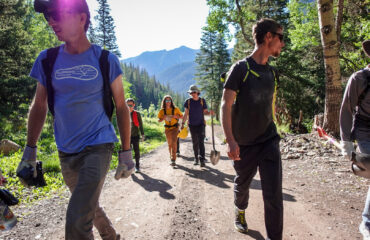
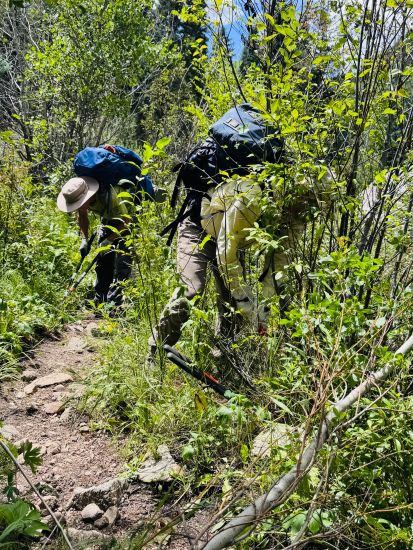
“Timber!”, volunteers call playfully as a two-inch diameter, six-foot tall aspen tree topples into the trail, bouncing off bushes on its way down. We had apologized to the tree before cutting it down. As we make our way along the trail—clearing vegetation to widen the corridor—it helps to remember that aspen trees are one gigantic, interconnected organism. Taking out individual aspens is more akin to trimming fingernails than actually killing trees.
The San Juan Mountains are home to millions of acres of federally managed public lands that include National Forest (NF), Bureau of Land Management (BLM), and Bureau of Reclamation (BOR) lands. While National Forest lands alone cover 6,712,766 acres (San Juan, Rio Grande, Grand Mesa, Uncompahgre, and Gunnison NFs), their combined motorized and non-motorized trail mileage of 6,500 miles roughly takes up just o.o4% of the total area.
It is incredibly important to keep this small amount of land clear. Allowing access for human endeavors helps keep our wonder alive (see the August Stewards of the Land [SOTL] column.) often resulting in the desire to protect these lands. Some might argue that to truly protect these special places, we need to reduce the number of trails and discourage humans from entering, but there will always be trails whether we maintain them or not. Just last week, I followed a moose trail to a stunning mountain lake. Moreover, I’ve seen extensive damage caused by erosion where humans and animals alike struggle to find the path of least resistance around fallen trees. They unwittingly create multiple paths with no one being any better than the other. The impact from this erosion can extend well beyond the trail corridor.
For years, local trails groups like Durango Trails, Mancos Trails Group, Southwest Conservation Corps, Ouray Trail Group, The Colorado Trail Foundation and Colorado Fourteeners Initiative (just to name a few!) have been doing incredible work. They clear fallen trees, cut back willow thickets, and maintain drains and tread—among other, larger tasks. In short, they do a ton! There are also outfitters and private citizens who remove fallen trees. It truly takes a village.
Historically, the stewards of the land at San Juan Mountains Association (SJMA) have been known more for our public education outreach than for our trail work. But a decline in forest health has coincided with a continually dwindling budget for FS recreation staff. Much of the workload formerly shouldered by FS seasonal crews is now shared with SJMA’s wilderness crew and forest ambassadors (see the June and July SOTL.)
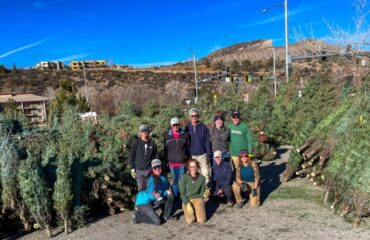
Along with the efforts cited in those articles, SJMA volunteers have stepped up their trail work along some of our most popular trails—Colorado Trail Segment 25.1 and the Pine River Trail. A major goal along the later is to open the trail corridor for pack animals between Lake Creek and Flint Creek. This is a major artery of the nearly 500,000 acre Weminuche Wilderness. One could explore for weeks without crossing a road. Pack animals access this relatively easy trail to bring in tools and resupplies for wilderness trail crews. In fact, pack animals ferry supplies for crews across a bevy of area trails. Special thanks to volunteers at the Four Corners and San Juan Backcountry Horsemen!
SJMA is proud to have our volunteers as part of this great village of local trail supporters. The next time you don’t have to step over a log, don’t have a branch whack you in the face, or are not hiking through puddles, remember all the hard work it took to provide access to this mountain paradise while keeping so much of it pristine and untouched.
MK Thompson is the Volunteer Coordinator for San Juan Mountains Association. When she isn’t writing about her backcountry misadventures, she’s actively living them with her two dogs and her fellow villagers.