
It Begins With Curiosity
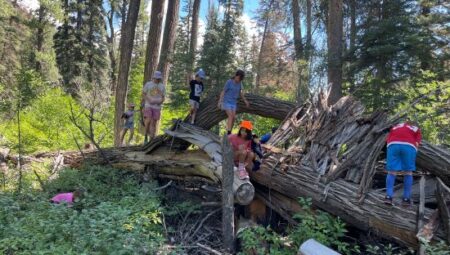
“You wanna see something cool?” Ben asks, a twinkle in his eye and mischief in his voice. He’s met with squeals of delight as a half dozen seven-year-olds clamber along a giant downed tree and crowd around him. Ben holds a strip of decaying bark, which he tilts forward to reveal its underside, speckled with a white-web-like substance. It’s a cacophony of “Woah! Cool!” “What is that?!” “Let me see!” as Ben begins his lesson.
Ben is one of our illustrious camp counselors, a recent Fort Lewis graduate, passionate about natural history and connecting youth to wild places. He also has a wealth of knowledge on mycelium. (Imagine an apple. That’s the mushroom. The mycelium, however, is its root system that allows the mushroom to absorb nutrients from its environment). Today, I’m lucky enough to be one of his students, and I can’t help but be impressed; Ben embodies SJMA’s education team’s trademark excellence of professionalism, expertise and childlike wonder.
What, precisely, does wonder mean? Naturally curious, I looked it up. A wonder is a marvel or feeling of awe. To wonder is to feel curiosity. Less than three weeks into my new position as Executive Director, tagging along with our summer camp program along the Dolores River, I not only learned something new about fungi, but I was reminded of something essential to effective stewardship, whether that be of the land, or an organization: It begins with curiosity.
Many are asking, “Ashley, what’s your plan for SJMA”. Early on, I thought I should have a pithy elevator-pitch answer. However, Rachel Carson reminds us, “It is a wholesome and necessary thing for us to turn again to the Earth and in the contemplation of her beauties to know of wonder and humility.” I believe the same is true of learning the ropes of an organization.
To open oneself up to wonder, one must ask more questions than assert statements. As a former teacher, I had a higher bar for “paying attention”, aligned with Kathleen Dean Moore’s definition: “Wonder is the open eyes, the sympathetic imagination and respectfully listening ears”. My plan for now is to keep my eyes and ears wide open. I hope to apply the same sense of wonder I observed in Ben’s students to the staff, volunteers, and community partners who make up SJMA’s own mycelium.
And I believe the same is essential for all of us endeavoring to be good stewards of the land. SJMA’s tagline is “Explore, Learn, Protect” and there’s a reason we list them in that order. Curiosity, wonder and attention transform time outdoors into a desire to learn about, and ultimately, protect those places. “This is wonderful” becomes “this must remain”.
SJMA not only works with local youth, but we also seek to instill in our visitors a sense of appreciation and respect for the landscapes of Southwest Colorado. We greet them at trailheads with wag bags and LNT lessons, and welcome them to our visitor centers to pore over maps to help plan day hikes and multi-day backpacking trips. But we also share our wonder, and the fruits of that wonder: the relationships we’ve formed with the natural world through attention, curiosity, and privileged time among quaking aspen groves and alpine tundra meadows, watching thunderheads build on the horizon and knowing when to high-tail it off a peak before the storm arrives. As Gary Snyder once wrote, “if you do know what is taught by plants and weather you are in on the gossip and can truly feel more at home”.
Through our volunteer-led interpretive hikes and trailside chats with ambassadors, we let visitors in on the gossip. (By the way, check out our calendar of events!) As the new kid on the SJMA block, I don’t take that generosity for granted. For now, I’m simply doing my best to get in on the gossip. I can tell you, a great place to start is listening to the chatter of seven-year-olds as they build intricate fairy houses at the base of spruce trees and scour rotted logs for mycelium.
Ashley Carruth is SJMA’s Executive Director. Outside of work, you may find her exploring local trails by foot, ski, or bike with her spouse and two dogs, Hatch and Jumbo. L
- Published in Education
