Wildfire Preparedness Month
By Andy Hawk
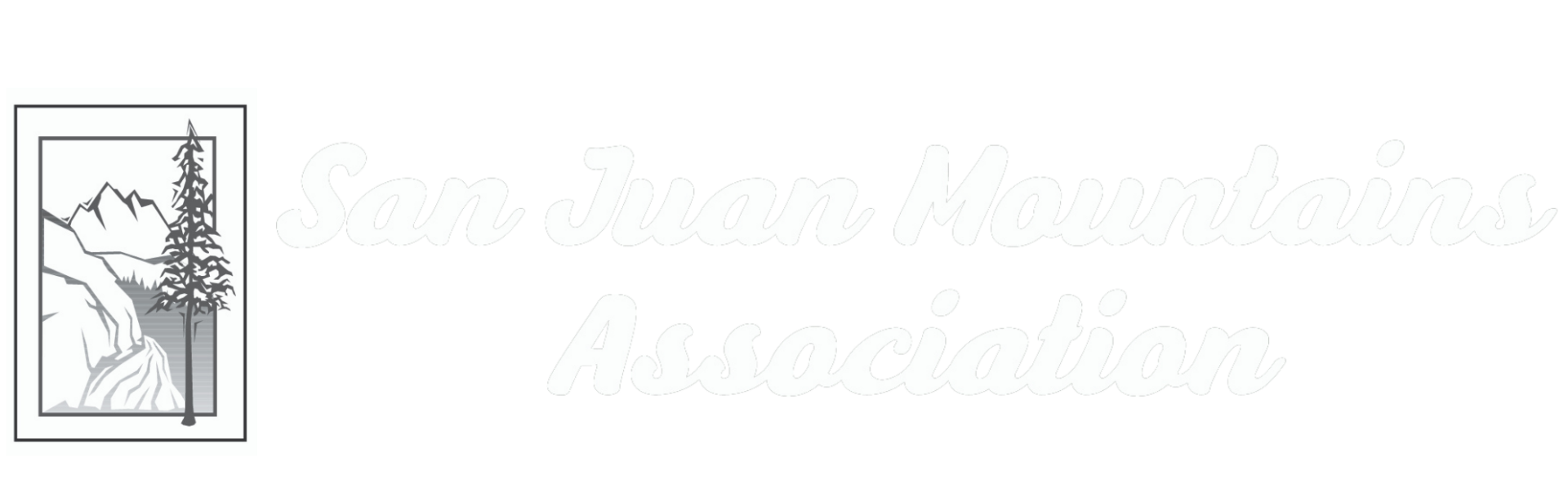
I recently found a “2002 Missionary Ridge Fire Facts” card hanging on a map of the San Juan National Forest near my desk. These facts are sobering and may bring many of the messages you will see this month into a particularly personal focus. The Missionary Ridge Fire ignited on June 9th and was not fully under control and extinguished until July 28th. It burned 70,485 acres, was fought by over 4,000 personnel, destroyed 56 homes and businesses, and tragically took the life of Alan Wyatt. The 416 Fire of 2018 ignited on June 1st, burning actively until July 31st, consuming 54,130 acres. Both fires evacuated roughly 1,300 homes and businesses, the sister scars parallel one another on opposite sides of the Animas River. To live in the west is to live with fire and current conditions indicate this could be an above average fire season.
Across Colorado, May signifies Wildfire Preparedness and Awareness Month. As we enter the month of May you will see messages from many of our state, federal, local, and non-profit partners regarding wildfire preparedness and education. Acting as a Steward of the Land is muli-faceted, one of which is understanding your role in fire preparedness. Whether you are on an email list from Wildfire Adapted Partnership, the La Plata County LPC Alerts system or are watching for press releases from your nearest Ranger District or BLM Office, you will see an uptick in outreach this month. La Plata County is hosting a Fire Ready! Expo on May 9th at the County Fairgrounds from 10:00am to 3:00pm. San Juan County, which is in the midst of updating their Community Wildfire Preparedness Plan (CWPP), uses Facebook and a Nixle Opt-in text messaging system to alert residents in the event of a fire. Archuleta County has just completed an exhaustive update to their CWPP and Ouray County has an emergency alert portal available on the County webpage.
These plans and resource hubs contain community and even neighborhood level recommendations, from home hardening, ignition zone evaluation and subdivision escape routes. We are fortunate to live in a region which has strengthened its communication and planning muscles. This muscle memory is built from past experience with fire, some of it displacing and difficult, but it does provide us with resources to refer to as temperatures increase, vegetation dries, and lightning may be seen hitting nearby ridgelines. Our region is also strong in organizations who provide us with resources and information to tuck away, much like the recommended “go bag”.
At SJMA, our Visitor Information Services desks and phone lines are springing to life with visitors and locals alike seeking information about dispersed camping, fire restrictions, and wisely, advice on how to recreate carefully during abnormally dry conditions. As you tone your hiking, trail running, rowing, and cycling muscles, it would be wise to activate your awareness of messaging for fire awareness and preparedness this month. The communities and organizations of Southwest Colorado have opted-in and are fully engaged this May, consider finding the nearest and most accurate source of information to keep you wildfire aware and prepared.
Andy Hawk, Associate Director of SJMA resided in Helena Montana during the summers of the big Yellowstone National Park Fires of the late 1980’s. His memories of months of ash and smoke guide his fire awareness and preparedness to this day.
- Published in Stewardship
The power of collaboration
By Andy Hawk
The verb collaborate is “to work jointly with others or together especially in an intellectual endeavor.” Collaboration, the noun, might need a subdefinition of; messy, slow, argumentative, and occasionally illogical, but in the end, enormously rewarding. In 2019, our community embarked on a journey of collaboration, with the goal of improving forest health, supporting wildlife resources, protecting watersheds, returning healthy fire to our landscape and executing projects that knit together the array of jurisdictions and land ownerships common to our region. Stakeholders, representing numerous local and regional nonprofits, local government bodies, federal and state agencies, and regional businesses, sat down at the table to create what would become the Southwest Colorado Collaborative Forest Landscape Restoration Program. SJMA has had a seat at this community table from day-one, and we continue to represent our key values of Explore, Learn, Protect in these collaborative conversations today.
Fast forwarding nearly six years, through pandemic, drought and abundance, agreement and litigation, some of what was originally conceived in those early conversations can now be seen taking shape in our region. With funding provided to the San Juan National Forest, via the USDA CFLRP, projects such as the recently completed Junction Creek road chip-seal, the ongoing Grassy Mountain Shared Stewardship project, and the soon to begin Durango Hills fuels reduction project are the culmination of collaborative work and community voices. The fate of the USDA CFLRP is uncertain, but our community did well by engaging early and sticking to the vision that collaboration, as fractious and nonlinear as it can be, is what makes our natural world better.
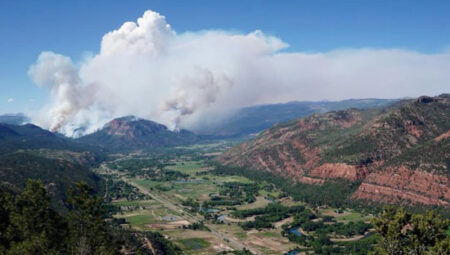
Why on earth would funding for forest health be used for road work? This question resulted in some robust, not always agreeable conversations among CFLPR stakeholders. The answer is tied to other community planning efforts, the Junction, Falls Creek Integrated Management Plan Environmental Assessment and the Durango Northwest Recreation Environmental Assessment specifically. As odd as it may seem, the work to pave and improve the parking area at the Colorado Trail trailhead and to chip-seal the first few miles of the Junction Creek road, on the San Juan National Forest, are tied to goals of the SW CO CFLRP. To be able to conduct work at the human powered scale, and at the scale of logging equipment requires access. Additionally, the Junction Creek corridor is a priority fireshed for Durango and outlying subdivisions. With the rehabilitation of the road, the greater watershed is now primed for access, allowing for stream bank rehabilitation along the water course, hand thinning of small fuels on steep slopes and sensitive areas, mechanical thinning and mastication on other areas, and even activities such as small-scale commercial timber harvest.
How does SJMA fit into the pile of spaghetti that is collaboration? Well, we are often the translator of acronyms, the conveyor of facts at the Visitor Information Services desk, and the encouraging voice of the educator on a field trip for eager outside learners. Our Forest Ambassadors, with support from Care for Durango, were at the Colorado Trailhead this summer educating users about the chip-seal project, asking for patience during delays on the road and conveying the message that it takes years to plan, fund and execute the work but when finished, these projects open the door to many more opportunities. While we do not know the future of some of the local collaborative efforts, we do know we can share in the successes of the last six years of efforts put in by stakeholders, from a wide range of community sectors. While you are out and about enjoying the treasure that is our home region this summer and fall, take a moment to consider just how many public hands have played a role in what you see on public lands.
Andy Hawk is SJMA’s Associate Director.
- Published in Education, News, Stewardship, Uncategorized
Wildfire Preparedness and Mitigation Succeeds Through a Collaborative Approach
By Andy Hawk
As we have all recently witnessed, it is never too soon to discuss wildfire preparedness and mitigation. Whether it is through one of the regional forest collaboratives, a home ignition zone evaluation, or a planning meeting with an HOA, living in one of the Nations’ Priority Firesheds takes a collaborative approach. Although it is only February, please be certain the extensive networks of governmental officials, scientists, citizens, educators, and fire professionals are already executing plans which have been developed via community processes over many years.
Local government staff, US Forest Service and Bureau of Land Management fire professionals, fire mitigation contractors, consulting foresters, wildlife scientists, and education organizations such as San Juan Mountains Association (SJMA) gather around a collaborative table monthly discussing and planning for the inevitable threat our communities, ranchers, and land managers face when a fire has grown beyond healthy and beneficial for the landscape into something catastrophic.
One of SJMA’s three key tenets is “Learn.” We must learn from subject matter experts and experienced professionals before we can then, in turn, educate others. Southwest Colorado is fortunate to have well-established groups of diverse stakeholders such as the 4-Rivers Resilient
Forest Collaborative, known locally as “4-Rivers,” in La Plata and San Juan counties as well as the Dolores Watershed Collaborative in Montezuma County to provide such a valuable information sharing and learning environment.
SJMA’s role at these community tables is to both learn and to educate, which is a very welcome role indeed. We take project scoping documents from National Forest planning endeavors to our teams of dedicated staff and volunteers, helping them understand what is happening across the region. Our education team takes the evolving realm of fire ecology and fire adaptation into the outdoor classrooms and experiential labs in which regional kids thrive. We amplify the voices of organizations such as Mountain Studies Institute, Wildfire Adapted Partnership, the Wildfire and Watershed Protection Fund, Durango Fire Protection District, the La Plata County Wildfire Information Center, and many others so our community has access to as much information as possible. Our network of volunteers and Forest Ambassadors can then take these learnings to the growing numbers of visitors who are here to escape the heat of home, bag a peak on the
list, spend an unforgettable afternoon sitting in solitude while absorbing the expanse of a flower filled meadow or connecting a young child to our precious outdoor resources.
This late winter and early spring, in a year when current snow water equivalents are not promising, I encourage you to take advantage of the fire planning, fire mitigation, fire preparedness, and forest health resources which have been developed by our community over a decade or more. Fire is in the bones and bedrock of our region, it is our job to be educated and prepared.
Andy Hawk is the Associate Director of SJMA, he takes delight in sharing stories of a life lived thus far up and down the spine of the country.
- Published in Education, Stewardship
